.png)

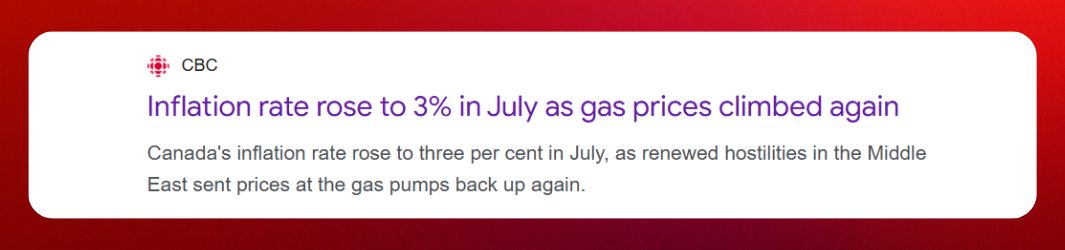
Canada’s inflation rate moved higher in July, rising to 3.0% year-over-year from 2.8% in June.
Higher gasoline and travel costs were major contributors to the increase, while grocery price growth showed some signs of easing.
For buyers, sellers and homeowners, inflation remains an important number to watch because it can influence the Bank of Canada’s interest rate decisions and, ultimately, borrowing costs.
⛽ Higher Gas Prices Drive Inflation Up
Gasoline was one of the biggest factors pushing inflation higher in July.
Gas prices increased 25.7% compared with a year earlier, accelerating from a 20.5% annual increase in June.
Statistics Canada attributed some of this pressure to renewed conflict in the Middle East and disruptions affecting major shipping routes.
June had provided some temporary relief as geopolitical tensions eased and energy prices cooled, but July saw some of that pressure return.
✈️ Canadians Paid More for Travel
Travel was another area where consumers felt higher prices.
Increased demand for hotels and flights to U.S. destinations surrounding the FIFA World Cup, combined with higher jet fuel costs, contributed to rising travel expenses.
Air transportation prices increased 12% year-over-year in July, compared with 9.6% in June.
Some of this pressure could be temporary as World Cup-related demand passes and energy prices change.
🛒 Some Relief at the Grocery Store
While overall inflation increased, grocery price growth actually slowed.
Food purchased from stores was 3.1% more expensive than a year earlier, down from a 3.9% annual increase in June.
Slower price growth for fresh vegetables, chicken and cereal products helped bring grocery inflation lower.
Fresh fruit moved in the opposite direction, rising 6.1% year-over-year, with berries and melons seeing particularly noticeable increases.
Despite the improvement, grocery prices continue to rise faster than overall inflation and have now done so for 18 consecutive months.
📊 Underlying Inflation Remains Relatively Stable
Looking beyond gasoline, inflation remained more contained.
CPI excluding gasoline increased 2.2% year-over-year in July, unchanged for the third consecutive month.
This figure should not be confused with the Bank of Canada’s preferred core inflation measures, CPI-trim and CPI-median. Those measures came in slightly stronger than economists expected but remained relatively contained.
That distinction matters because the Bank looks beyond the headline inflation number when deciding whether interest rates need to change.
🏦 What Does This Mean for Interest Rates?
July’s inflation report is particularly important because it is the final CPI report before the Bank of Canada’s next interest rate announcement on September 2.
The Bank has maintained its policy rate at 2.25% for six consecutive decisions.
Although headline inflation increased to 3%, economists at BMO and CIBC do not currently see enough inflation pressure to require an immediate rate increase. Both expect the Bank of Canada to hold its policy rate in September.
Of course, inflation is only one part of the Bank’s decision. Employment, economic growth, consumer spending and other economic indicators will also play a role.
🏠 What Could This Mean for Home Buyers and Sellers?
For the real estate market, the biggest question is what inflation means for borrowing costs.
If inflation remains relatively stable, the Bank of Canada may have more room to continue holding its policy rate. Greater stability in interest rates can make it easier for buyers to understand their borrowing costs and plan their home search.
For sellers, borrowing costs can also influence how many buyers are actively participating in the market and how much purchasing power they have.
However, a single inflation report does not determine where mortgage rates or the housing market will go next. Buyers and sellers should consider the broader economic picture alongside their own finances, timeline and local market conditions.
